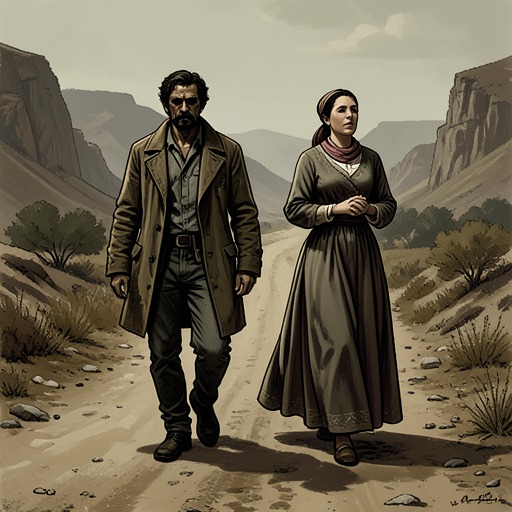
Ana Félix
Don QuixoteAna Félix is a Morisco woman raised in the Christian faith, whose story turns on an identity the authorities refuse to recognize, a love divided by exile, and a reunion that transforms a search for buried wealth into the recovery of a daughter. Captured after a voyage from Barbary, she is bound and faces a sentence when she asks the Viceroy of Barcelona to hear her history. Her account exposes how displacement has separated her from both Don Gaspar Gregorio and her father, Ricote.
Identity and Exile
Ana explains that she was born to Morisco parents but brought up as a Catholic Christian. She says that her mother was Christian and that her father shared the faith; she had been taught and raised in it, and insists that her Christianity was genuine rather than an outward pretense. Yet when the expulsion came, her declaration could not keep her in her birthplace: her uncles took her to Barbary, treating her claim as an excuse to remain behind.
Her family’s flight had already divided them. Her father, anticipating the expulsion, had left in search of refuge and hidden a substantial store of pearls, precious stones, and gold, entrusting the secret location to Ana and instructing her not to touch it. She crossed to Barbary with her uncles and other relatives and neighbors, while her father remained elsewhere, unaware of where she had gone. The concealed treasure thus binds her to a homeland she has been forced to leave and to a father from whom she has been separated.
Don Gaspar Gregorio and the Journey
Despite the seclusion in which she lived, Ana and Don Gaspar Gregorio, the eldest son of a neighboring gentleman, found opportunities to meet and fell in love. When her uncles took her into exile, Don Gaspar chose to accompany her. Knowing the Morisco language, he joined the departing group and made himself their companion during the voyage, concealing that he was a Christian man.
In Algiers, the king heard of Ana’s beauty and wealth and summoned her. When Don Gaspar’s identity became a danger, Ana asked permission to dress him in women’s clothing before presenting him at court. The king, believing him to be a woman, decided to keep him and send him as a gift to the Grand Signor, placing him in the care of high-ranking Moorish women. Ana’s account makes the disguise a desperate means of protecting her beloved, but it leaves the couple separated and Don Gaspar in peril.
The king arranged for Ana to return to Spain to recover the hidden treasure. She sailed in a brigantine with two Turks and a Spanish renegade, while the rest of the crew served as rowers. The Turks, fearing that Ana and the renegade might reveal the vessel’s presence if put ashore, instead kept to the coast in hopes of taking a prize. The brigantine was discovered, and the ensuing encounter brought Ana before the Viceroy with her hands bound; Don Gaspar remained behind in Algiers, dressed as a woman and exposed to danger.
Her Appeal and Ricote’s Recognition
When the Viceroy is prepared to carry out the sentence, Ana asks him to delay long enough to hear her story. She distinguishes herself from the people punished for the actions of their community, describing her Christian faith and the circumstances that brought her to Barbary. The Viceroy is moved by her account and unbinds her hands. The immediate change is significant, but the evidence leaves the question of her ultimate legal status unresolved at this point.
As Ana finishes, an elderly pilgrim throws himself at her feet and recognizes her as his daughter. He is Ricote, returned from Germany to search for her and to recover the treasure he had buried. Ana embraces him, and Ricote tells the Viceroy and the others that she is his daughter. Sancho Panza, present on the galley, recognizes Ricote from their earlier meeting after Sancho left his governorship and understands that the young woman is his daughter.
Ricote explains that he found the hidden wealth but had not found Ana until this encounter. The reunion reverses the story’s material emphasis: the treasure sought across borders matters less to him than the daughter he has recovered. He asks that their innocence and grief be considered in granting clemency, while Ana’s unbinding and reunion with her father offer relief without establishing the final decision.
Narrative Significance
Ana’s story places personal testimony against the blunt category imposed on her. Though expelled as a Morisco, she presents herself as a Christian formed by her parents’ faith, and her forced departure separates her from both the man she loves and the father who had sought refuge for the family. Her case shows how religious identity, family loyalty, and the consequences of expulsion intersect without resolving neatly into the labels used by those in power.
The sequence also turns on concealment and recognition: Don Gaspar survives by appearing to be someone he is not, the family’s wealth remains buried and distant, and Ricote returns in a pilgrim’s dress before recognizing his daughter. Ana’s own account makes her an active witness to these events, while the reunion gives her narrative a personal conclusion even as Don Gaspar’s fate and the authorities’ final response remain unsettled in the evidence presented here.